Sonny Styles and the Evolution of the NFL Linebacker
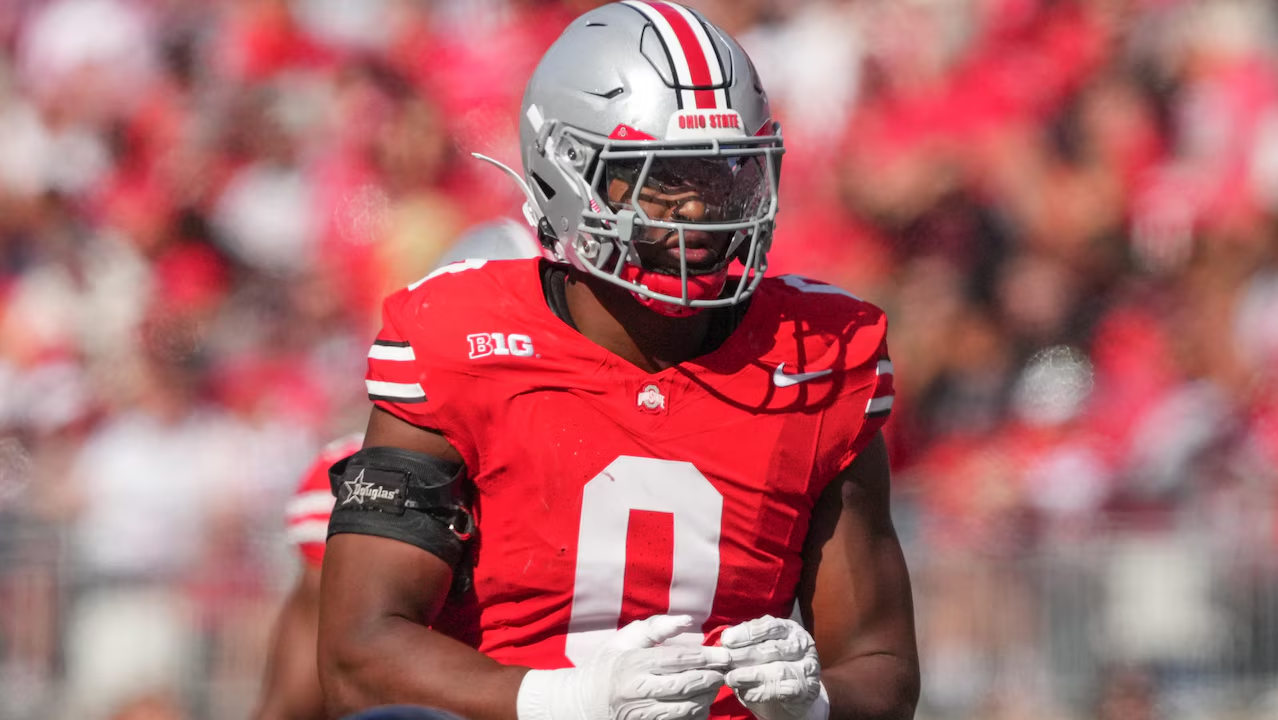
Credit: Jason Mowry | Getty Images
Sonny Styles is a next-level defender and the epitome of what the linebacker position has evolved into in today’s NFL.
Styles arrived at Ohio State Buckeyes in 2022 as a safety. That matters. Because even before the full-time transition to linebacker, the traits that define these modern hybrid linebackers were already present on film.
Against Michigan in 2023, aligned at safety, Styles triggered downhill and kept Blake Corum out of the end zone — finding the football naturally in traffic. In that same game, he matched up with tight end Colston Loveland in space, worked to the flat, and forced an incompletion. Those are linebacker reps — executed from a DB alignment.
The move to linebacker over the past two seasons wasn’t a gamble. It was a progression. And it mirrors the broader evolution of the NFL linebacker position.
Three structural shifts have driven the change league-wide:
1. The Decline of Traditional Run Structures
Two-back concepts dropped from 16.8% of offensive plays in 2011 to 8% by 2015. The league moved away from fullback-heavy football, reducing the demand for 250-pound plug-and-play thumpers.
2. The Expansion of Space-Based Passing Attacks
Shotgun formations, RPOs, quick-game concepts, and bubble screens surged between 2010–2020. Offenses increasingly isolated running backs and tight ends in coverage. Linebackers were forced to defend in space — not just fill gaps.
3. Sub-Package Football Becoming the NFL’s Base Defense
Nickel personnel became the NFL’s base defense (59% of snaps by 2020), while three-linebacker sets dropped to 25%. In this league, if you cannot cover, you cannot stay on the field.
The physical profile adjusted accordingly. The 2024 draft class averaged just 231.8 pounds at linebacker — the second-lightest mark in two decades. Speed became currency. Versatility became mandatory.
Think Fred Warner, Roquan Smith, and Zack Baun — 220–240 pound defenders who log 400+ coverage snaps, rush the passer, and produce 100-tackle seasons. In comes Sonny Styles.
At 6-foot-4 and roughly 245 pounds, Styles ran a reported 4.37 40-yard dash. That number alone reframes the conversation. Linebackers are not built like that — at least they weren’t.
And his film backs it up. Against Texas in the playoff, now aligned at linebacker, Styles was orchestrating pre-snap signals, settling into zone, and detonating on crossing tight ends. He bent the edge on blitzes, showing legitimate pass-rush ability.
One game after another, six playoff contests, two national championship appearances — production under the brightest lights. Ohio State built portions of its “diamond” defensive looks around him — freeing him to run, scrape, blitz, and match.
And the evolution still isn’t complete.
The modern NFL linebacker must transcend packages. He must carry verticals from tight ends, match running backs in man, blitz off the edge, and still meet backs in the hole.
Sonny Styles started at safety. He finished as the centerpiece of a national championship-caliber defense.
This is not just about positional evolution.
This is about a defender who can reshape how an NFL coordinator builds his defense.